
There’s a quiet revolution happening in the mornings of the world’s most effective people. While the rest of the world is hitting snooze, scrolling their phones, and scrambling to get out the door, a specific type of person is already three steps into their day — clear-headed, energised, and deli…
There’s a quiet revolution happening in the mornings of the world’s most effective people. While the rest of the world is hitting snooze, scrolling their phones, and scrambling to get out the door, a specific type of person is already three steps into their day — clear-headed, energised, and deliberately building the life they want.
They’re not masochists. They’re not morning people by accident. They’ve engineered their mornings specifically because they understand something most people don’t: how you start your morning determines the trajectory of your entire day.
And no, this isn’t about the controversial 4am club or hustle culture platitudes. It’s about the specific, evidence-based rituals that high-performers use to consistently show up as their best selves — before most people have had their first cup of coffee.
Before we get into the habits, it’s worth understanding why morning routines carry such outsized importance. The answer lies in how your biology works across a 24-hour cycle.
In the first 60-90 minutes after waking, your cortisol levels naturally spike — this is the cortisol awakening response, and it’s your body’s built-in alertness system. Combined with rising melatonin suppression (triggered by light exposure) and elevated growth hormone from sleep, you’re in a neurochemical window that primes you for focused, productive work. The choices you make in that window shape whether you enter an upward or downward spiral for the rest of the day.
High-performers don’t leave this to chance. They’ve learned to protect this window fiercely, because they know it’s their most valuable cognitive resource of the day.
This is the non-negotiable foundation. And it’s the one most people get wrong immediately.
Your phone is a dopamine delivery device. Every notification — an email, a news headline, a social media reaction — triggers a tiny hit of dopamine that compels you to check again. In the first 90 minutes after waking, before your prefrontal cortex is fully online, you’re particularly vulnerable to this. The dopamine loop takes hold before your rational brain can push back.
High-performers don’t check their phones until they’ve completed their morning protocol. Some use physical phone locks (like a Clocky-style device that requires physical movement to disable). Others put the phone in another room entirely. The specific method matters less than the commitment: until [specific morning anchor task], no phone.
This single habit can transform your mornings more than any other on this list. It protects the clarity you’ve built overnight from the fragmentation that phone checking creates.
Your circadian rhythm — the 24-hour biological clock that regulates nearly every physiological process — is set primarily by light exposure. Specifically, morning light. The bright light signals to your suprachiasmatic nucleus (the master clock in your hypothalamus) that it’s daytime, which suppresses melatonin production and initiates the cascade of hormonal changes that make you alert and energised.
Studies show that 10-30 minutes of bright morning light exposure significantly improves evening sleep propensity, increases daytime alertness, and elevates mood. The effect is dose-dependent: more bright light in the morning produces more robust circadian signalling.
High-performers get this light exposure first thing. Some go outside within five minutes of waking. Others work near a window with direct sunlight. On dark winter mornings or for night-owl types struggling with morning alertness, a high-lux light therapy lamp (10,000 lux) is a legitimate tool.
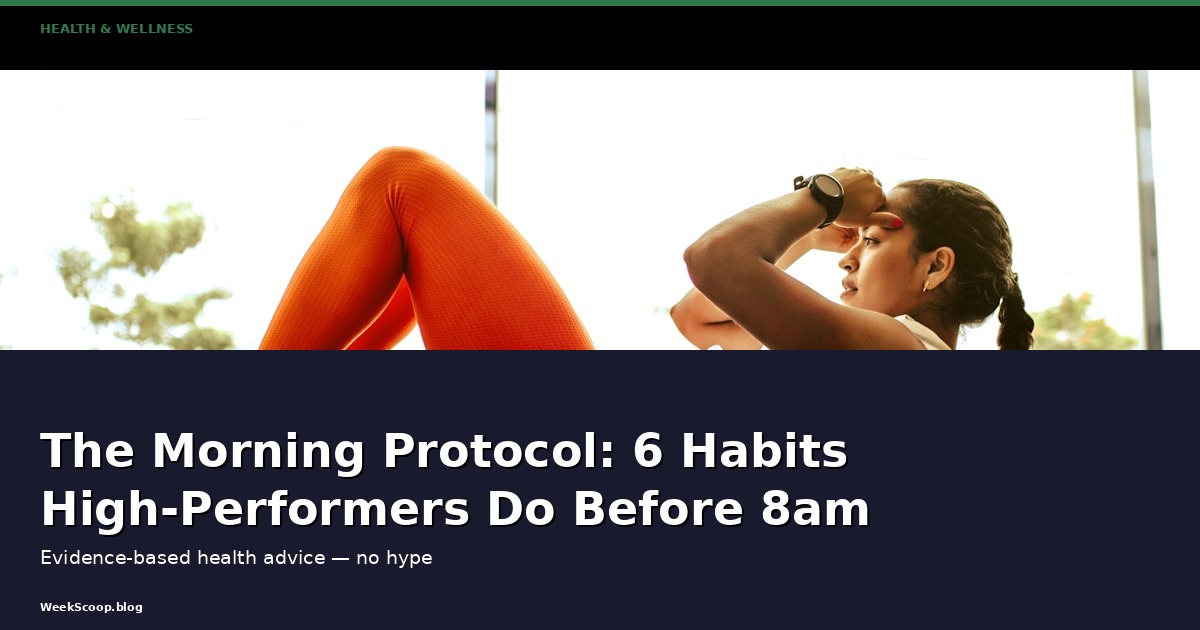
Not a five-minute stretch. Not a leisurely walk. A deliberate, purposeful movement practice that raises your heart rate and generates a specific physiological state.
The benefits are well-documented: exercise in the morning improves mood, enhances cognitive function for several hours afterward, regulates cortisol, promotes deeper nighttime sleep, and builds the physical resilience that high-performance requires. But there’s a nuance that separates high-performers from casual exercisers.
Most high-performers keep morning workouts low-to-moderate intensity. The goal isn’t to destroy yourself before the workday begins. It’s to activate the sympathetic nervous system just enough to generate alertness and energy without creating recovery debt that impairs afternoon and evening cognitive function. Zone 2 cardio — exercise at 60-70% of max heart rate — is a common choice. So is yoga, particularly forms that incorporate breathwork (pranayama) which independently activates parasympathetic relaxation while you’re stimulating sympathetic arousal through movement.
After seven to eight hours without water, you’re mildly dehydrated when you wake. Your blood viscosity is elevated, your cognitive function is impaired, and the fatigue you might attribute to poor sleep is sometimes partly dehydration. This is particularly true if you’ve consumed alcohol the previous evening.
High-performers drink water — often 500ml or more — before consuming any caffeine. Some add a pinch of high-quality sea salt (for sodium and trace minerals), a squeeze of lemon (for vitamin C and flavour), or a small amount of electrolyte drink for hydration support. The goal is immediate rehydration, not eventual.
Only after this hydration protocol do they allow coffee or tea. The caffeine hits a hydrated system and produces a cleaner, more sustainable alertness response than caffeine hitting a dehydrated, cortisol-elevated body first thing in the morning.
High-performers plan their mornings the night before. Every element. Every sequence. No decisions in the morning — the decisions were made when the prefrontal cortex was fresh and the day’s demands were clear.
This is specifically different from to-do list thinking. It’s not about cramming more tasks into the morning. It’s about designing the morning to produce a specific psychological state: a sense of completion, agency, and momentum before the day’s demands begin arriving.
For some, this is writing 500 words — a creative output that feels complete by 7:30am. For others, it’s completing a specific work task that’s been on the back burner. The principle is: by the time most people are checking their first email, the high-performer has already experienced a win. They’ve already demonstrated to themselves that they control the morning, not the other way around.
Here’s where this gets specific to your biology. The high-performer morning protocol isn’t just about habits — it’s about supporting the underlying neurological and metabolic machinery that makes those habits effective.
One tool that fits cleanly into this protocol: Java Burn. This is a powdered coffee supplement that combines natural compounds — including L-theanine, caffeine, and green tea extract — designed specifically to support sustained morning cognitive function without the mid-morning crash. Unlike standard coffee, which delivers a rapid spike and subsequent decline, the L-theanine in Java Burn smooths the caffeine absorption and extends the alertness window.
Used as part of the morning protocol — after hydration, after light exercise, as the cognitive work window opens — it extends the cortisol-awakening benefit rather than fighting it. The result is four to five hours of clean, focused energy at the exact time when the high-performer is executing their most important work.
It’s not a replacement for the habits. It’s an amplifier — one that works precisely because the foundation (sleep, light, movement, hydration) is already in place.
The temptation is to implement all six at once. Don’t. That’s a recipe for abandonment by week two.
Instead, start with the non-negotiables: no phone for 90 minutes and direct sunlight within 30 minutes of waking. These two alone will shift your morning dramatically. Add the others sequentially — one per week — until the full protocol is embedded.
Your future self — the one who consistently shows up clear-headed, energised, and in control of their morning — is waiting on the other side of this. The only question is whether you start today or keep postponing until Monday.
Start today. Tomorrow morning, be the high-performer who already won the day before 8am.



Leave a Reply